Trump Sees AI’s Economic Promise While Dismissing Potential Threats
📅 January 9, 2026
✍️ Editor: Sudhir Choudhary, The Vagabond News

Donald Trump has outlined a sharply optimistic view of artificial intelligence, emphasizing its economic potential while downplaying warnings about long-term risks, signaling how a future Trump-led administration might approach one of the most transformative technologies of the modern era.
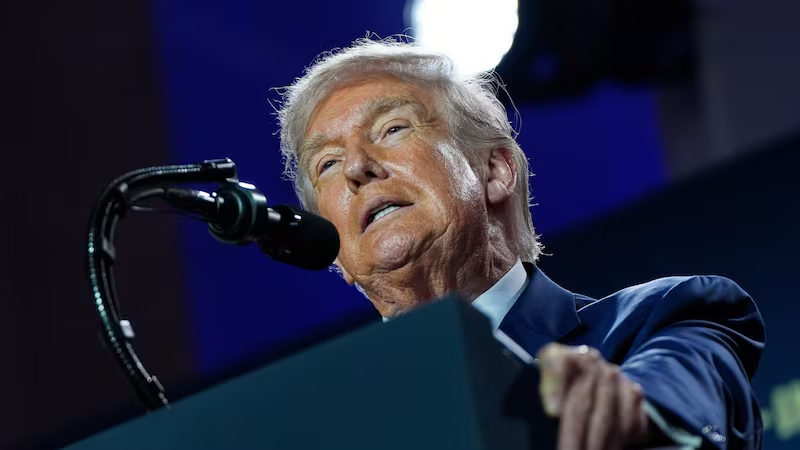
Speaking during a recent public appearance, Trump described artificial intelligence as a “tremendous opportunity” for U.S. growth, competitiveness, and job creation, arguing that fears surrounding the technology are often exaggerated. He framed AI as a strategic asset that could help the United States outpace rivals, particularly China, in productivity, innovation, and military capability.
AI as an Economic Engine
Trump said AI-driven industries could generate trillions of dollars in economic value if allowed to develop with minimal regulatory constraints. He highlighted potential gains in manufacturing automation, healthcare diagnostics, logistics, and defense systems, portraying AI as a force that could “supercharge” American industry.
According to Trump, aggressive regulation at an early stage would risk pushing innovation overseas. “If we overregulate, we lose everything,” he said, warning that foreign competitors would seize technological leadership if U.S. companies were constrained by what he characterized as excessive caution.
His remarks echo a broader pro-business stance that prioritizes rapid commercialization and private-sector leadership over precautionary frameworks proposed by some policymakers and researchers.
Dismissing Long-Term Threat Warnings
While acknowledging that AI carries risks, Trump dismissed concerns about existential threats, mass unemployment, or loss of human control as speculative. He criticized what he called “doomsday narratives” promoted by parts of the academic and tech policy community, arguing that similar fears accompanied earlier technological revolutions.
“We’ve heard this before with every new technology,” Trump said, likening AI anxieties to past warnings about computers and automation. In his view, market forces and American ingenuity would naturally adapt, creating new jobs even as others are displaced.
This position places Trump at odds with several AI researchers and industry leaders who have called for guardrails to prevent misuse, bias, large-scale labor disruption, and potential national security risks.
Contrast With Current Policy Approaches
The Trump comments stand in contrast to the more cautious regulatory tone adopted by the current administration and international bodies, which have emphasized ethical standards, transparency requirements, and risk assessments for advanced AI systems.
European regulators, in particular, have advanced comprehensive AI legislation aimed at limiting high-risk applications. Trump suggested such frameworks could become a competitive disadvantage, saying the U.S. should not “copy Europe’s rulebook.”
Supporters argue that a lighter regulatory touch could attract investment and accelerate breakthroughs. Critics counter that insufficient oversight could expose the public to harmful applications, including surveillance abuse, deepfake misinformation, and unsafe autonomous systems.
Industry and Political Reactions
Tech industry responses to Trump’s remarks were mixed. Some venture capitalists and startup founders welcomed his emphasis on speed and scale, saying innovation thrives when government sets broad goals rather than detailed rules.
However, labor groups and digital rights advocates expressed concern that dismissing AI risks could leave workers and consumers unprotected. “Economic promise without safeguards often means social costs,” said a policy analyst with a Washington-based technology think tank.
Politically, Trump’s stance reinforces a familiar narrative: growth-first economics paired with skepticism toward regulatory institutions. As AI becomes a central issue in future elections, his framing may resonate with voters focused on jobs and national competitiveness.
Implications for U.S. Technology Leadership
AI is increasingly viewed as a cornerstone of geopolitical power, influencing everything from military strategy to economic dominance. Trump’s comments suggest he sees AI primarily through this strategic lens, prioritizing national advantage over collaborative global governance.
Whether that approach would accelerate innovation or amplify risks remains a subject of intense debate. What is clear is that AI policy is moving from a niche technical discussion into a defining political issue.
Conclusion
Trump’s embrace of AI’s economic promise, coupled with his dismissal of long-term threats, signals a deregulatory vision centered on speed, competition, and market-driven solutions. As artificial intelligence continues to reshape economies and societies, the divide between rapid innovation and precautionary oversight is likely to deepen. Trump’s comments add momentum to that debate, underscoring how future U.S. leadership could shape not only domestic technology policy but the global AI landscape.
Tags: Artificial Intelligence, Donald Trump, U.S. Technology Policy, AI Regulation, Economic Growth
Source: Public remarks and political policy analysis
News by The Vagabond News