


Tejas crash: Exclusive, Shocking jolt to IAF system
📅 2025-11-22
✍️ Editor: Sudhir Choudhary, The Vagabond News
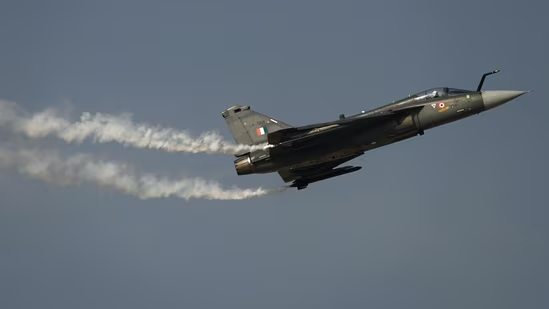

A sombre pall has descended over the international aviation community after a Tejas crash was reported during a demonstration at the Dubai Airshow on Friday, jolting the Indian Air Force (IAF) and raising urgent questions about air-display safety protocols. Early accounts from the venue indicate that the Light Combat Aircraft (LCA Mk-1) went down during an aerobatic routine, with emergency crews rushing to the scene within minutes. Some reports have identified the pilot as Wing Commander Namansh Syal; however, official confirmation on identity and precise cause is awaited as authorities continue their assessment. The Vagabond News is tracking developments closely.
Tejas crash: What we know so far
– The incident occurred during a scheduled flight display slot at the Dubai Airshow, a marquee global event that regularly features frontline combat aircraft and precision aerobatics.
– Eyewitnesses describe a high-energy maneuver preceding the loss of altitude, after which smoke and debris were seen near the display axis. Onsite rescue teams intervened immediately.
– Event organizers and local emergency services have yet to issue a comprehensive preliminary report. The IAF and Hindustan Aeronautics Limited (HAL), the manufacturer of the Tejas LCA, are expected to collaborate with show authorities in a joint investigation.
– While some media accounts have named the pilot as Wing Commander Namansh Syal, authorities have not publicly released a formal statement detailing the pilot’s identity, condition, or sequence of events. Any attribution at this stage remains provisional.
Pilot identification and official response
The Tejas program is operated by the IAF with production by HAL and sustained support from a wide ecosystem of Indian aerospace and defense partners. In the immediate aftermath of the Tejas crash, standard protocol involves securing the crash site, grounding demonstration sorties of the affected type pending safety reviews, and preserving flight data recorders and telemetry logs. Officials commonly convene a Court of Inquiry to evaluate pilot briefings, aircraft health data, weather conditions, and display profiles filed with the airshow’s safety director.
Multiple sources at the venue reported a rapid cordon and temporary suspension of the display to ensure spectator safety and allow investigators uncontested access to the area. As of press time, neither the Dubai Airshow authority nor the IAF has released an official causal statement. The Vagabond News has reached out to both entities for comment and will update this report as verified information becomes available.
The aircraft and its display profile
The Tejas LCA Mk-1 is a single-engine, multi-role fighter designed for air defense, strike, and training roles, notable for its composite airframe and advanced avionics. At airshows, the platform typically performs a mix of high-alpha passes, tight turns, rolls, and vertical climbs that demonstrate thrust-to-weight and control authority. Each display is pre-briefed, risk-assessed, and flown within strict altitude and speed gates to minimize exposure. The Tejas crash, occurring within such a controlled envelope, will likely prompt a meticulous examination of pre-flight checks, maintenance logs, and any late-stage technical advisories issued to the display team.
Safety record and questions ahead
Airshows incorporate multiple overlapping layers of safety: display lines that keep aircraft at a safe distance from spectators, minimum altitudes for maneuvers, and staggered routines to reduce traffic density. Despite this, aerial demonstrations remain inherently high-risk, especially when showcasing tight, aggressive maneuvers. Investigators will focus on whether the aircraft experienced a mechanical anomaly, loss of situational awareness, environmental factors such as wind shear, or a combination thereof.
Historically, the Tejas program has cleared numerous milestones, including operational induction with the IAF, successful weapons trials, and export marketing campaigns. Any Tejas crash, particularly on an international stage, will be scrutinized not only for its immediate cause but for broader implications on airworthiness directives, pilot currency for display flying, and risk thresholds mandated by show organizers.
International implications and next steps
High-profile incidents at global venues inevitably carry diplomatic, industrial, and reputational dimensions. The Dubai Airshow is a key marketplace where nations showcase aerospace capabilities to prospective partners. For India, the Tejas represents an indigenous technological achievement aimed at both strengthening domestic squadrons and attracting export interest. In the wake of this Tejas crash, analysts anticipate:
– A temporary pause on certain demonstration profiles until the inquiry identifies safe operating margins.
– A cross-check of fleet maintenance bulletins and potential software or hardware advisories for similar configurations.
– Renewed emphasis on pilot display training, with scenario-based rehearsals to account for edge-of-envelope contingencies.
Human cost and community impact
Beyond the technical and programmatic consequences lies the human cost that reverberates through squadrons, families, and the global aviator community. When a display pilot is lost or injured, units initiate welfare protocols, counseling support, and memorial observances. If the pilot is confirmed to be Wing Commander Namansh Syal, the IAF fraternity will mourn a trained professional who accepted extraordinary risks in the service of demonstration flying and national representation. The Vagabond News will refrain from definitive naming until authorities issue formal confirmation.
What readers should watch for
– Official statements from the IAF, Dubai Airshow management, and HAL, including any preliminary findings.
– Flight data and cockpit recording analyses that can clarify mechanical status and pilot inputs prior to the crash sequence.
– Updates on show schedules, including whether the Tejas display team will resume flying or modify routines.
– Any international airworthiness advisories affecting similar platforms or display operations.
As the investigation proceeds, The Vagabond News urges readers to treat circulating videos and unverified claims with caution. We will continue to publish updates grounded in official releases and corroborated accounts. The Tejas crash has shaken confidence and stirred difficult questions, but it also underscores the precision, discipline, and courage intrinsic to military aviation—and the imperative to learn every possible lesson to keep crews and spectators safe.
News by The Vagabond News


